Entry #3
January 7, 2025
Would you believe me if I told you that some of the first GI research was done on a tiny island in the Great Lakes of Michigan? Let me tell you about a unique world called Mackinac Island [pronounced like “mack-en-naw” – don’t let me hear any “mack-in-ack” malarkey]. A place accessible only by ferry boat or private plane where no cars or motorized vehicles roam the streets, just humans, bikes, and horses. Imagine a world where your Amazon delivery came by horse trailer! With a teeny perimeter of 8.2 miles paved by Michigan State Highway M-185, you can bike around the entire island in no time. As a born Michigander, I traveled Up North to this special spot most summers – check out some of my photos below!
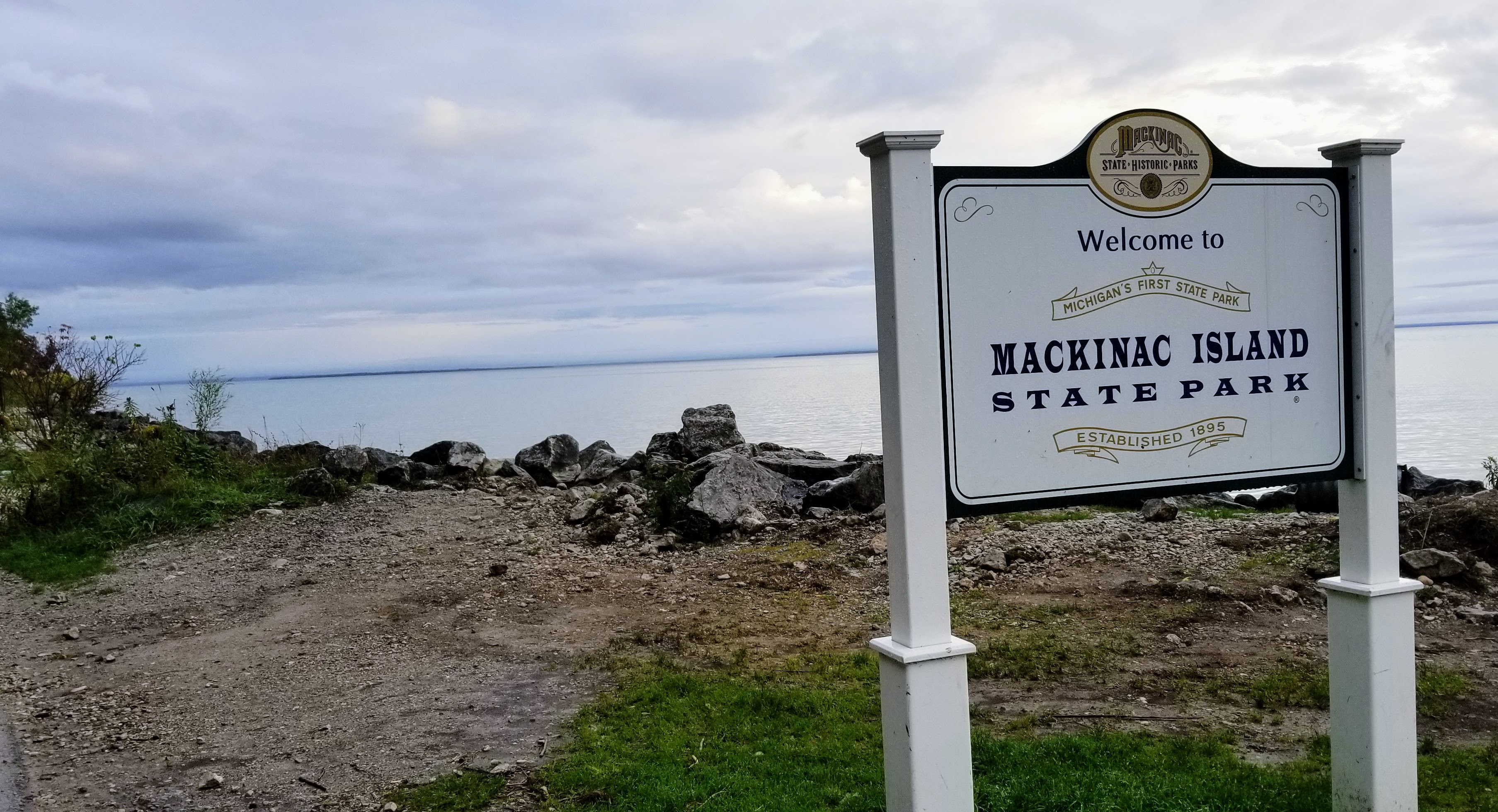




Mackinac Island is rich with history. It was originally home to the Anishnaabek (Ojibwe, Odawa, and Potawatomi) tribes who gave the island its name, “Michilimackinac”, meaning “Great Turtle”. The island was their home, a meeting place, and sacred burial site. Once colonized by Europeans in the 17th century (booo) it became a center for fur trading and was even the site of two battles between the Continental and British armies during the War of 1812.

Some time after the war ended, the local American Fur Company Store became the site of an event that surely was the talk of its tiny island town. In June of 1822, 28 year old Canadian voyager Alexis St. Martin was struck in the abdomen by an accidental short range musket fire. Luckily for St. Martin (or maybe not so lucky) there was an Army surgeon stationed at the Fort. Even though he had only one year of formal medical training, Dr. William Beaumont had years of experience treating soldiers during the war.

I’ll spare the gory details, but after many failed treatment attempts to seal the wound, it fused with the skin of St. Martin’s abdomen; a permanent opening, a window into the stomach. When he ate food, it would fall out of him, but he was alive so I guess you can call that a win-lose situation. Taking advantage of St. Martin’s shocking new development, Beaumont conducted 238 experiments on his patient for several years to study digestion. He published his results in an 1833 book Experiments and Observations on the Gastric Juice and the Physiology of Digestion. The first few experiments were done on Mackinac Island, followed by research in Mississippi, Washington D.C., and New York.
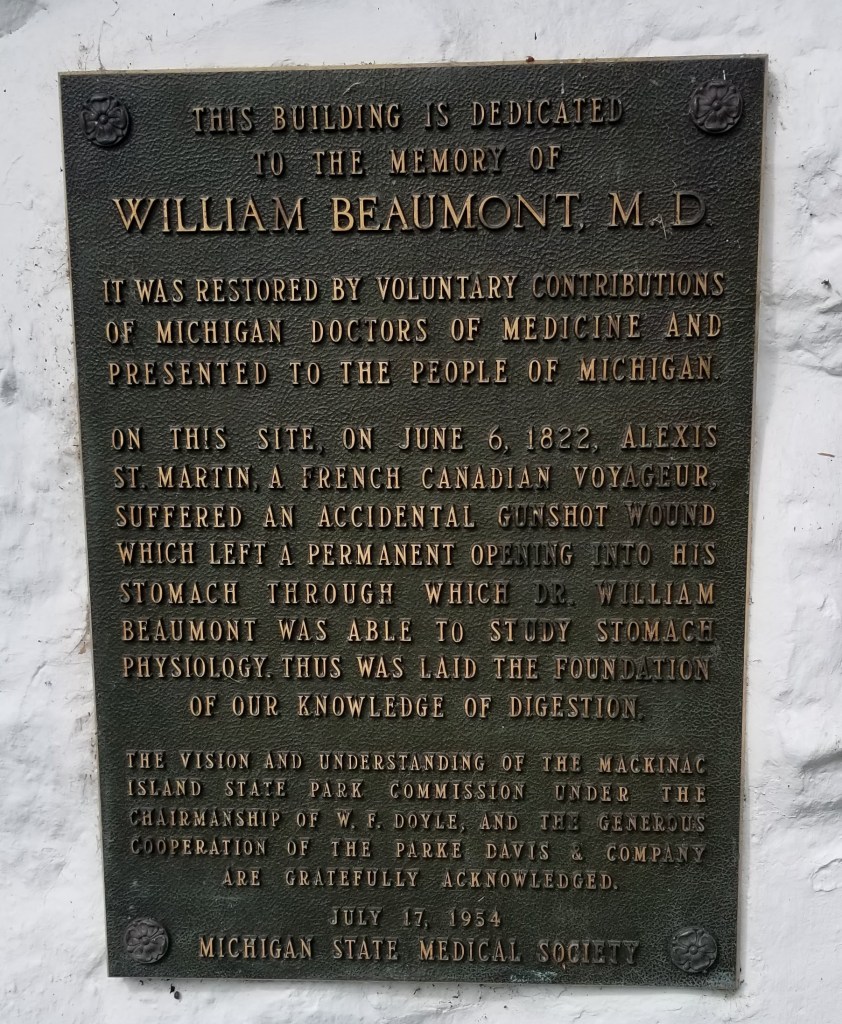
Beaumont discussed observations from: inserting a thermometer to measure stomach temperature, dangling different types of food on a string through the hole to see what happened over time, and even tasting the gastric juices to confirm its acidity. While shocking, these experiments settled many debates around the topic of digestion including its chemical nature.
Though his work was undoubtedly transformative for the field of medicine and a fascinating approach to research, it was full of ethical violations. Beaumont treated St. Martin as nothing more than his guinea pig. First forced to live in Beaumont’s home as a servant, St. Martin was the victim of long experiments where he would be inspected on the hour. In the later years of Beaumont’s poking and prodding, St. Martin traveled along with him to various locations (which must have been considerably awkward for the two since St. Martin only spoke French and Beaumont only English). After many arduous years, St. Martin finally stood his ground requesting more payment for his troubles and wanting more time with his wife and six children.
Karma eventually came for Beaumont. In 1840 he treated a man with a head injury by cutting a hole to relieve pressure, but the patient did not survive. The cunning lawyer accused Beaumont of drilling the hole in the man’s skull just to see what was inside, the same as what he did to St. Martin’s stomach. Beaumont died in 1853, a year after hitting his head on an icy staircase.
St. Martin passed in 1880. Though he outlived his doctor by 27 years, his body was left out to decompose before being buried in an unmarked grave to ward off any curious medical minds of the future. Beaumont did not even bother to ask his patient’s age. In his book, he documented St. Martin as being 18 years old, which 140 years later at St. Martin’s long overdue grave marking, was it discovered he was actually 28.
I learned a lot while writing this article, hopefully you will too by reading it! Mackinac Island was always a favorite childhood vacation destination for me, but now that I am older I see it with new eyes. Ironically, I completed my PhD in a lab dedicated to the intricate structure of the intestine. The next time I visit, I will reflect on the revolutionary history that came before the tourists and fudge shops.
CC
Sources:
- mackinacisland.org
- mackinacparks.com
- William Beaumont. (1833) Experiments and observations on the gastric juice, and the physiology of digestion. Plattsburgh, NY: F.P. Allen.
- Lissa Edwards. “The Gruesome Medical Breakthrough of Dr. William Beaumont on Mackinac Island”, mynorth.com
- Kat Eschner. “This Man’s Gunshot Wound Gave Scientists a Window Into Digestion”, Smithsonian Magazine
- Martha Hayden. “Mackinac Island – History”, restless-viking.com
- Steven Logsdon. “William Beaumont’s momentous and unethical experiments”, Wash U School of Medicine Bernard Becker Medical Library
 Science, Vicariously
Leave a comment